Overloading, type classes and type checking
In looking at Haskell so far we have seen two kinds of function which work over more than one type. A polymorphic function such as length has a single definition which works over all its types. On the other hand, overloaded functions like equality, + and show can be used at a variety of types, but with different definitions at the different types.
The chapter starts with a discussion of the benefits of overloading, before looking at type classes, which are collections of types; what the members of a class have in common is the fact that certain functions are defined over the type. For instance, the members of the equality type class, Eq, are those types which carry an equality function, ==. Type classes are thus the mechanism by which overloaded functions can be given types in Haskell.
We shall see how to define type classes and types which belong to these classes: the instances of the class. Haskell’s prelude and libraries contain a number of classes and instances, particularly for numeric types – we survey these, referring readers to the Haskell report (Marlow 2010) for a full exposition.
We then look at how type inference and type checking work in Haskell, first looking at types without type variables – monomorphic definitions – and then at polymorphic, overloaded definitions, and see how they are given types, illustrated by a series of examples.
Related videos online
Why overloading?
Type classes
Type class tour I
Managing types
Monomorphic type checking
Polymorphic type checking
Unification
Three type checking examples
Type checking and type classes
Week 9 summary
Why overloading?
This section looks at the reason for including overloading in Haskell; we do this by looking at a scenario.
Suppose that Haskell did not have overloading, and that we wanted to check whether a particular element is a member of a list of type Bool. We would define a function like
elemBool :: Bool -> [Bool] -> Bool
elemBool x [] = False
elemBool x (y:ys)
  = (x ==Bool y) || elemBool x ys
where we have written ==Bool for the equality function over Bool.
Suppose now that we want to check whether an integer is a member of an integer list, then we need to define a new function
elemInt :: Int -> [Int] -> Bool
which differs from elemBool only in using ==Int instead of ==Bool. Each time we want to check membership of a list of a different type we will have to define yet another – very similar – function. One way out of this problem is to make the equality function a parameter of a general function
elemGen :: (a -> a -> Bool) -> a -> [a] -> Bool
but this gives too much generality, because it can be used with any parameter of type a -> a -> Bool rather than just an equality function. More importantly, using this definition the parameter has to be passed in explicitly each time the function elemGen is used, like this
elemGen (==Bool)
making programs less easy to read.1 The alternative is to define a function which uses the overloaded equality,
elem :: a -> [a] -> Bool
where the type a has to be restricted to those types a which have an equality. The advantages of this approach are
-
Reuse The definition of
elemcan be used over all types with equality. -
Readability It is much easier to read
==than==Intand so on. This argument holds particularly for numeric operators, where it is more than tiresome to have to write+Int,*Floatand so on.
What this discussion shows is that a mechanism is needed to give a type to functions like elem: that is precisely the purpose of type classes.
Introducing classes
The elem function appears to have the type
elem :: a -> [a] -> Bool
but elem only has this type for types a which have an equality function. How is this to be expressed? We need some way of saying whether we have an equality function over a given type. We call the collection of types over which a function is defined a type class or simply a class. For instance, the set of types over which == is defined is the equality class, Eq.
Defining the equality class, Eq
How do we define a class, such as Eq? We say what is needed for a type a to be in a class. In this case we need a function == defined over a, of type a->a->Bool.
class Eq a where
  (==) :: a -> a -> Bool
In general we will specify an interface or signature which has to be implemented for a type to belong to the class.
Members of a type class are called its instances, and a type is made into an instance by giving an implementation of the interface for that type. This is called an instance declaration. Built-in instances of Eq include the base types Int, Float, Bool, Char. Other instances are given by tuples and lists built from types which are themselves instances of Eq; examples include the types (Int,Bool) and [[Char]].
Not all types will necessarily carry an equality; we may choose not to define one, for reasons of information hiding, or there may be no natural way of defining an equality on a particular type.
For example, function types like Integer -> Integer are not instances of Eq, since there is no way that we can write a program which will decide whether two functions over Integer have the same behaviour, that is have the same values at every possible input.
‘Instances’ in Haskell
It is unfortunate that the term instance is used in two different ways in Haskell. We talked in Generic functions: polymorphism of a type
t1being an instance of a typet2, when we can substitute for a type variable int2to givet1. Here we have talked about a type being an instance of a class. It should be clear which one we mean from the context of a discussion, but it’s helpful to bear this ‘overloading’ of terminology in mind.
Functions that use equality
Many of the functions which we have defined so far use equality over particular types. The function
allEqual :: Int -> Int -> Int -> Bool
allEqual m n p = (m==n) && (n==p)
decides whether three integers are equal. If we examine the definition itself, it contains nothing which is specific to integers; the only constraint it makes is that m, n and p are compared for equality. Their type can be a for any a in the type class Eq. This gives allEqual a most general type thus:
allEqual :: Eq a => a -> a -> a -> Bool
allEqual m n p = (m==n) && (n==p)
The part before the => is called the context. We can read the type as saying that
allEqualhas typea -> a -> a -> Boolfor all typesain the classEq(that is, all typesafor which==is defined)
This means that allEqual can be used at many types, including these
allEqual :: Char -> Char -> Char -> Bool
allEqual :: (Int,Bool) -> (Int,Bool) -> (Int,Bool) -> Bool
since both Char and (Int,Bool) belong to Eq.
What happens if we break this constraint by trying to compare three functions for equality? If we define
suc :: Integer -> Integer
suc = (+1)
and try to evaluate
allEqual suc suc suc
    No instance for (Eq (Integer -> Integer))
      arising from a use of `allEqual' at <interactive>:1:0-19
    Possible fix:
      add an instance declaration for (Eq (Integer -> Integer))
    In the expression: allEqual suc suc suc
    In the definition of `it': it = allEqual suc suc suc
which conveys the fact that (Integer -> Integer) is not in the Eq class, and suggests that the way to fix the problem is to add an instance declaration for that type.
More equality examples
The elem example in Why overloading? will have the type
elem :: Eq a => a -> [a] -> Bool
and so it will be usable at the types
Bool -> [Bool] -> Bool
Int  -> [Int]  -> Bool
and so on. Many of the functions we have defined already use equality in an overloaded way. We can use GHCi to deduce the most general type of a function, such as the books function from the library database of A library database, by commenting out its type declaration in the script, thus
-- books :: Database -> Person -> [Book]
:type books
to the prompt. The result we get in that case is
books :: Eq a => [ (a,b) ] -> a -> [b]
which is perhaps a surprise at first. This is less so if we rewrite the definition with books renamed lookupFirst, because it looks up all the pairs with a particular first part, and returns their corresponding second parts. Here it is with its variables renamed as well
lookupFirst :: Eq a => [ (a,b) ] -> a -> [b]

lookupFirst ws x
  = [ z | (y,z) <- ws , y==x ]
Clearly from this definition there is nothing specific about books or people and so it is polymorphic, if we can compare objects in the first halves of the pairs for equality. This condition gives rise to the context Eq a. Finally from A library database, as we saw for books,
borrowed    :: Eq b => [ (a,b) ] -> b -> Bool
numBorrowed :: Eq a => [ (a,b) ] -> a -> Int
Summary
In this section we have introduced the idea of a class, which is a collection of types, its instances, with the property that certain functions described in an interface are defined over the type. One way we can think of a class is as an adjective: any particular type is or is not in the class, just as the weather at any particular moment might or might not be sunny.
We saw how equality could be seen as being defined over all the types in the class Eq. This allows many of the functions defined so far to be given polymorphic type, allowing them to be used over any type in the class Eq. In the following sections we explain how classes and instances are defined in general, and explore the consequences of classes for programming in Haskell.
Exercises
13.1 How would you define the ‘not equal’ operation, /=, from equality, ==? What is the type of /=?
13.2 Define the function numEqual which takes a list of items, xs say, and an item, x say, and returns the number of times x occurs in xs. What is the type of your function? How could you use numEqual to define member?
13.3 Define functions
oneLookupFirst  :: Eq a => [ (a,b) ] -> a -> b
oneLookupSecond :: Eq b => [ (a,b) ] -> b -> a
oneLookupFirst takes a list of pairs and an item, and returns the second part of the first pair whose first part equals the item. You should explain what your function does if there is no such pair. oneLookupSecond returns the first pair with the roles of first and second reversed.
Signatures and instances
In the last section we saw that the operation of equality, ==, is overloaded. This allows == to be used over a variety of types, and also allows for functions using == to be defined over all instances of the class of types Eq. This section explains the mechanics of how classes are introduced, and then how instances of them may be declared. This allows us to program with classes that we define ourselves, rather than simply using the built-in classes of Haskell.
Declaring a class
As we saw earlier, a class is introduced by a declaration like:
class Info a where
  examples :: [a]
  size     :: a -> Int
The declaration introduces the name of the class, Info, and this is followed by an interface or signature, that is a list of identifiers and their types. To be in the Info class the type a must carry the two bindings in the signature:
-
the
exampleslist, which is a list of objects of typea, which we can think of as giving a list of representative examples from the type, and, -
the
sizefunction, which returns a measure of the size of the argument, as an integer.
The general form of a class definition will be:
class Name ty where
  ... signature involving the type variable ty ...
Now, how are types made instances of such a class?
Defining the instances of a class
A type is made a member or instance of a class by defining the interface functions for the type. For example,
instance Eq Bool where
  True  == True  = True
  False == False = True
  _     == _     = False
describes how Bool is an instance of the equality class. The declarations that numeric types like Int and Float are in the equality class (and indeed other built-in classes) involve the appropriate primitive equality functions supplied by the implementation.
Although we have called the class Eq the equality class, there is no requirement that the == function we define has any of the usual properties of equality apart from having the same type as equality. It is up to the user to ensure that he or she makes sensible definitions, and documents them adequately.
Going back to our Info example, we might say
instance Info Char where
  examples = ['a','A','z','Z','0','9']
  size _   = 1
This gives a list of six typical characters and states that each character is of size one. We can also make Bool and Int instances of Info, like this:
instance Info Bool where
  examples = [True,False]
  size _   = 1

instance Info Int where
  examples = [-100..100]
  size _   = 1
In the examples for Bool we can list all the elements, for integers we choose a range of “small” numbers; as for characters, we say each object is of size one. Finally we can look at the data type of Shapes, and declare an instance for them:
instance Info Shape where
  examples = [ Circle 3.0, Rectangle 45.9 87.6 ]
  size     = round . area
Here we just list a couple of typical shapes, and use the area, rounded to an integer, as an indication of size
Instances and contexts
Suppose that the type a is in the Info classs: this means that we can estimate the size of a value in a, and we have a list of examples of type a. Using this function and list we are able to define a size function for [a] and a list of examples of type [a] like thisto define those functions over [a], so we can declare the following instance
instance Info a => Info [a] where ....
in which the context Info a appears, making clear that we are only providing information about lists of objects for which we already have information about the individual members.
Type error messages
We first saw the example of a type error message mentioning ‘instances’ in Errors and error messages where the application
4 doublegave rise to the error messageNo instance for (Num ((Integer -> Integer) -> t)) arising from the literal `4' at <interactive>:1:0-7 ...instead of the simple message “attempt to apply a number to a function”.
The problem is that we could have overloaded the numbers to have this sort of behaviour, but common sense suggest that we haven’t; it’s difficult, though, to get error messages to reflect common sense, because it it inconsistent and context-dependent. At least, though, we can now understand what is being said in the error message, even if the appropriate course of action is quite different … .
We can complete the definition like this
instance Info a => Info [a] where
  examples = [ [] ] ++
             [ [x] | x<-examples ] ++
             [ [x,y] | x<-examples , y<-examples ]
  size     = foldr (+) 1 . map size
Out list of examples is made up by the empty list, together with all the one and two element lists that can be built up from the examples of type a. So, in this definition we see overloading in action: on the left hand side of the examples is used at type [a], while on the right hand side the three occurrences are all at type a.
To estimate the size of a list of a we take the size of each element (map size), and add one to the total of these sizes using foldr (+) 1. Again, on the right-hand side of this definition we use size over the type a; this shows that we need the context which says that a is in the Info class.
Limitations
Instances in Haskell are global, so that once you have declared an instance for a type, that instance is the one that you will have to use with that type: in particular it isn’t possible to make instances local to a module or set of modules. If you still want to do this, the mechanism to use would be to define a ‘wrapped’ type, like
data WInt = Wrap Int
and to declare the instances you want for this type of integers.
There are also some limitations to what can be declared as an instance, in other words on what can appear after the => (if any) in an instance declaration. This must either be a base type like Int, or consist of a type constructor like [...], (...,...) or Shape applied to distinct type variables.
We will not be able, for example, to declare (Float,Float) as an instance; nor can we use named types (introduced by a type definition). More details of the mechanism can be found in the Haskell 2010 report (Marlow 2010).
Haskell 2010 vs. GHC Haskell
In fact, GHC implements a more flexible mechanism for type classes and instances, and choosing this option within GHC or GHCi using the flag
-XFlexibleInstancesallows us to move away from Haskell 2010. This can be achieved by putting this as the first line in a Haskell file, preceding themoduledeclaration:{-# OPTIONS_GHC -XFlexibleInstances #-}The problem with doing this is that your program becomes reliant on GHC rather than Haskell 2010, which is supported by a number of compilers, and also runs the risk of depending on a feature which might change. Sufficiently many Haskell programmers are prepared to take little risks like this that it is difficult to find a project of any size which is fully Haskell 2010 compliant.
Default definitions
To return to our example of equality, the Haskell equality class is in fact defined by
class Eq a where
  (==), (/=) :: a -> a -> Bool
  x /= y     = not (x==y)
  x == y     = not (x/=y)
To the equality operation is added inequality, /=. As well as this, there are default definitions of /= from == and of == from /=. These definitions have two purposes; they give a definition over all equality types, but as defaults they can overridden by an instance declaration.
At any instance a definition of at least one of == and /= needs to be supplied for there to be a proper definition of (in)equality, but a definition of either is sufficient to give both, by means of the defaults.
It is also possible to define both of the operations in an instance delaration , so that if we wanted to define a different version of /= over Bool, we could add to our instance declaration for Bool the line
x /= y = ... our definition ...
In our Info example you will probably have noticed that for many of the base types we simply said that the size of all the objects was one; we can add this as a default to the definition of Info like this:
class Info a where
  examples :: [a]
  size     :: a -> Int
  size _   = 1
and then the declarations for Int, Char and Bool become
instance Info Int where
  examples = [-100..100]

instance Info Char where
  examples = ['a','A','z','Z','0','9']

instance Info Bool where
  examples = [True,False]
Default or top-level?
If we want to stop a default being overridden, we should remove the operation from the class, and instead give its definition at the top level and not in the signature. In the case of the operation
/=inEqwe would give the top-level definitionx /= y = not (x == y)which has the type
(/=) :: Eq a => a -> a -> Booland will be effective over all types which carry the
==operation.There are some situations when it is better to give default definitions, which can be overridden, rather than top-level definitions, which cannot. Over the numerical types, for instance, an implementation may well supply all the operations as hardware instructions, which will be much more efficient than the default definitions.
Derived classes
Functions and instances can depend upon types being in classes; this is also true of classes. The simplest example in Haskell is the class of ordered types, Ord. To be ordered, a type must carry the operations >, >= and so on, as well as the equality operations. We say
class Eq a => Ord a where
  (<), (<=), (>), (>=) :: a -> a -> Bool
  max, min             :: a -> a -> a
  compare              :: a -> a -> Ordering
For a type a to be in the class Ord, we must supply over a definitions of the operations of Eq as well as the ones in the signature of Ord. Given a definition of < we can supply default definitions of the remaining operations of Ord. For instance,
x <= y     = (x < y || x == y)
x >  y     =  y < x
We will explain the type Ordering and the function compare in A tour of the built-in Haskell classes.
A simple example of a function defined over types in the class Ord is the insertion sort function iSort of Defining functions over lists. Its most general type is
iSort :: Ord a => [a] -> [a]
Indeed, any sorting function (which sorts using the ordering given by <=) would be expected to have this type.
From a different point of view, we can see the class Ord as inheriting the operations of Eq; inheritance is one of the central ideas of object-oriented programming.
Multiple constraints
In the contexts we have seen so far, we have a single constraint on a type, such as Eq a. There is no reason why we should not have multiple constraints on types. This section introduces the notation we use, and some examples where it is needed.
Suppose we wish to sort a list and then show the results as a string. We can write
vSort = show . iSort
To sort the elements, we need the list to consist of elements from an ordered type, as we saw above. To convert the results to a String we need [a] to be in the Show class (which we discuss in detail in the next section). To do this it is sufficient for each element of type a to be printable, and so the type of vSort is
vSort :: (Ord a,Show a) => [a] -> String
showing that a must be in both the classes Ord and Show. Such types include Bool, [Char] and so on.
In a similar way, suppose we are to use lookupFirst, and then make the results visible. We write
vLookupFirst xs x = show (lookupFirst xs x)
We have twin constraints again on our list type [(a,b)]. We need to be able to compare the first halves of the pairs, so Eq a is required. We also want to turn the second halves into strings, so needing Show b. This gives the type
vLookupFirst :: (Eq a,Show b) => [(a,b)] -> a -> String
Multiple constraints can occur in an instance declaration, such as
instance (Eq a,Eq b) => Eq (a,b) where
  (x,y) == (z,w)  =  x==z && y==w
which shows that a pair of types in Eq again belongs to Eq. Multiple constraints can also occur in the definition of a class,
class (Ord a,Show a) => OrdShow a
In such a declaration, the class inherits the operations of both Ord and Show.
In this particular case, the class declaration contains an empty signature. To be in OrdShow, the type a must simply be in the classes Ord and Show. We could then modify the type of vSort to say
vSort :: OrdShow a => [a] -> String
The situation when a class is built on top of two or more classes is called multiple inheritance; this has consequences for programming style, explored in Algebraic types and type classes.
infoCheck: a QuickCheck clone
We can define a stripped-down version of QuickCheck for ourselves, using the examples that the Info type class provides. Suppose we have these examples for type a: how do we check that a property of type a -> Bool? We want to check that the property holds for all the examples, so we apply it to all of them, using map and then take their conjunction, using and:
infoCheck :: (Info a) => (a -> Bool) -> Bool

infoCheck property = and (map property examples)  -- (infoCheck.1)
We could do a similar thing for a two argument property, defining
infoCheck2 :: (Info a, Info b) => (b -> a -> Bool) -> Bool

infoCheck2 property =
    and (map (infoCheck.property) examples)   -- (infoCheck.2)
Note that infoCheck2 uses infoCheck in its definition. Similarly we can define infoCheck3 and so on. We could stop here, but we can do better, using overloading to define a single infoCheck function, just as there is a single quickCheck function.
To do this we define another type class, and say that a type is Checkable if it’s something that can be checked by applying it to the examples given in an Info type:
class Checkable b where
 infoCheck :: (Info a) => (a -> b) -> Bool
What instances can we define? Well, the definition of (infoCheck.1) is the same as an instance declaration for Bool:
instance Checkable Bool where
  infoCheck property = and (map property examples)
The definition (infoCheck.2) gives us a way of making checkable functions with an additional argument,
instance (Info a, Checkable b) => Checkable (a -> b) where
  infoCheck property = and (map (infoCheck.property) examples)
Taking these together, we have infoCheck defined over all these types:
Bool -> Bool
Shape -> Bool
Int -> Shape -> Bool
Bool -> Int -> Shape -> Bool
In short, we can apply infoCheck to any type where the argument types are in the Info class, and where the result is a Bool, just as in the original definition of the quickCheck function.
Summary
This section has explained the basic details of the class mechanism in Haskell. We have seen that a class definition specifies a signature, and that in defining an instance of a class we must provide definitions of each of the operations of the signature. These definitions override any default definitions which are given in the class declaration. Contexts were seen to contain one or more constraints on the type variables which appear in polymorphic types, instance declarations and class declarations.
Exercises
13.4 How would you make Move, playing cards (as defined in Extended exercise: cards and card games), and triple types, (a,b,c), into Info types?
13.5 [Harder] Moving beyond Haskell 2010 to use the -XFlexibleInstances for GHCi, declare instances of Info for Int -> Bool and Int -> Int.
13.6 Give an instance of Info for the Float type, and using this re-define the instance of Info for the Shape type.
13.7 What is the type of the function
compare x y = size x <= size y ?
13.8 Complete the default definitions for the class Ord.
13.9 Complete the following instance declarations:
instance (Ord a, Ord b) => Ord (a,b) where ...
instance Ord b => Ord [b] where ...
where pairs and lists should be ordered lexicographically, like the words in a dictionary.
A tour of the built-in Haskell classes
Haskell contains a number of built-in classes, which we briefly introduce in this section. Many of the classes are numeric, and are built to deal with overloading of the numerical operations over integers, floating-point reals, complex numbers and rationals (that is integer fractions like 22/7). Rather than give complete details of the numeric types, we give an exposition of their major features. Full details of the base classes are given in the Haskell 2010 report (Marlow 2010), and their dependencies are illustrated in The Haskell Base classes, adapted from the Haskell 2010 report.
Equality: Eq
Equality was described above; to recap, we define it by
class Eq a where
  (==), (/=) :: a -> a -> Bool
  x /= y   =  not (x==y)
  x == y   =  not (x/=y)
Ordering: Ord
Similarly, we build the ordered class on Eq:
class (Eq a) => Ord a where
  compare              :: a -> a -> Ordering
  (<), (<=), (>=), (>) :: a -> a -> Bool
  max, min             :: a -> a -> a
The data type Ordering contains three values LT, EQ and GT, which represent the three possible outcomes from comparing two elements in the ordering, and is defined thus:
data Ordering = LT | EQ | GT
The advantage of using compare is that a single function application decides the exact relationship between two inputs, whereas when using the ordering operators – which return Boolean results – two comparisons might well be necessary. Indeed, we see this in the default definition of compare from == and <=, where two tests are needed to reach the results LT and GT.
  compare x y
    | x == y      = EQ
    | x <= y      = LT
    | otherwise   = GT
The defaults also contain definitions of the ordering operators from compare:
  x <= y          = compare x y /= GT
  x <  y          = compare x y == LT
  x >= y          = compare x y /= LT
  x >  y          = compare x y == GT
There are default definitions for all the operations of Ord, but we need to supply an implementation of either compare or <= in order to give an instance of Ord.
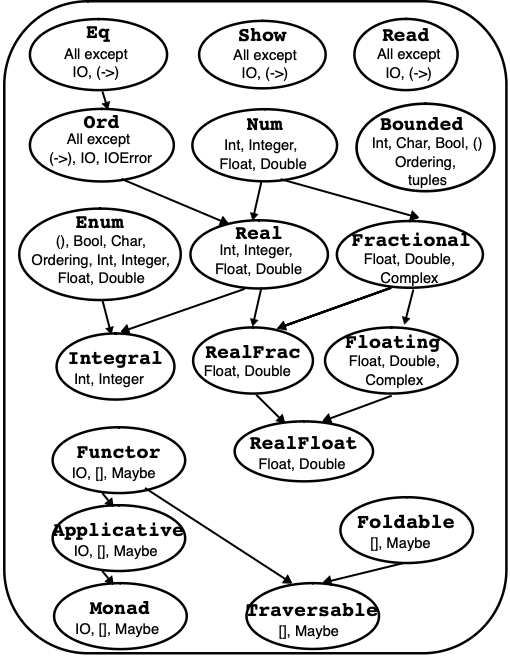{#ClassesDiagram width=“3.5in”}
Finally we have default definitions for the maximum and minimum operations,
  max x y
    | x <= y      = y
    | otherwise   = x
  min x y
    | x <= y      = x
    | otherwise   = y
Most Haskell types belong to these equality and ordering classes: among the exceptions are function types, and some of the abstract data types we meet below in Abstract data types.
Enumeration: Enum
It is useful to generate lists like [2,4,6,8] using the enumeration expression
[2,4 .. 8]
but enumerations can be built over other types as well: characters, floating-point numbers, and so on. The class definition is
class (Ord a) => Enum a where
  succ, pred       :: a -> a
  toEnum           :: Int -> a
  fromEnum         :: a -> Int
  enumFrom         :: a -> [a]              -- [n .. ]
  enumFromThen     :: a -> a -> [a]         -- [n,m .. ]
  enumFromTo       :: a -> a -> [a]         -- [n .. m]
  enumFromThenTo   :: a -> a -> a -> [a]    -- [n,n' .. m]
where enumFromTo and enumFromThenTo have default definitions, which we leave as exercises for the reader.
The signature of the class also contains operations fromEnum and toEnum which convert between the type and Int. Finally, the class contains succ and pred which step through the enumeration upwards and downwards: when succ is called at the greatest element, an error is returned.
Confusingly, the Haskell report states that ‘these functions [toEnum and fromEnum] are not meaningful for all instances of Enum’, and using these operations over floating-point values or full precision integers will result in a run-time error.
Full instances of the class include Int, Char, Bool and other finite types like Ordering.
Bounded types: Bounded
The Bounded class is specified by the declaration
class Bounded a where
  minBound, maxBound :: a
and the two values give the minimum and maximum values in these types. The types Int, Char, Bool, Ordering belong to this class. Types that are in both Bounded and Enum obey some extra constraints that are explained in detail in the Haskell 2010 report (Marlow 2010).
Turning values to strings: Show
The standard prelude defines the class Show, which contains types whose values can be written (or ‘shown’) as strings.
type ShowS = String -> String

class Show a where
  showsPrec :: Int -> a -> ShowS
  show      :: a -> String
  showList  :: [a] -> ShowS
The function showsPrec supports flexible and efficient conversion of large data values, but in an introductory context, the function
show :: a -> String
which converts a value into a string is all that is needed. The class contains default definitions of showsPrec from show and vice versa. Further details about how to exploit the subtleties of showsPrec can be found in Hudak et al. (2000).
Most types belong to the class Show, but absent are function types and IO. For other types, example instance declarations might be
instance Show Bool where
   show True  = "True"
   show False = "False"

instance (Show a, Show b) => Show (a,b) where
   show (x,y) = "(" ++ show x ++ "," ++ show y ++ ")"
In fact we discuss how some function types might be shown in DSLs for computation: generating data in QuickCheck.
Turning strings to values: Read
The class Read contains types whose values can be read from strings. To use the class it is enough to know about the function
read :: (Read a) => String -> a
The result of a read may not be properly defined: there needs to be exactly one object of the required type in the input string (which may optionally also contain whitespace or nested comments); in any other case the read will fail with an error. More details of how strings are parsed in this way can be found in Case study: parsing expressions.
It is also important to see that in many cases the type of the result of the read has to be specified, since it could potentially be of any type in the class Read. For instance, we can write
(read " 1 ") :: Int
which indicates that in this case we require the result of the read to be an Int. Without this type declaration we get this error on evaluating (read " 1 "):
Ambiguous type variable `a' in the constraint:
  `Read a' arising from a use of `read' at <interactive>:1:0-8
Probable fix: add a type signature that fixes these type variable(s)
The class Read complements Show, since strings produced by show are usually readable by read. Many types can be read, but exclusions include function types.
The Haskell numeric types and classes
One of the purposes of the Haskell design was to build a functional programming language which had a strong type system – in which any type errors in definitions and expressions are found before evaluation – yet which contains a rich set of numeric types, as befits a language suitable to substantial ‘real world’ tasks. Among Haskell’s numeric types are
-
The fixed precision integers,
Int, and the full precision integers,Integer, which represent all integers faithfully. -
The floating-point numbers,
Float, and the double-precision floating-point numbers,Double. -
Rational numbers, that is fractions, represented as ratios of integers; built-in is the type
RationalofIntegerfractions. -
Complex numbers, which can be built over other types such as
Float.
The design also required that the usual operations like + and / and literals such as 23 and 57.4 would be overloaded. For instance, Int and Integer will carry identical operations3 and have identical literals, as indeed will Float and Double; a guide to the operations over integers and floats was given in The integers: Integer and Int and Floating-point numbers: Float. This overloading can lead to situations where the type of an expression is undetermined; in such a case we can give an explicit type to an expression, thus:
(2+3)::Int
The Haskell report (Marlow 2010), Section 4.3.4, discusses a mechanism by which a default type can be given to numeric expressions. These default directives mean that whole numbers are taken to be Integer and others to be Double in the absence of any other type information. This can be seen in action in this snapshot of GHCi:
Prelude> let myadd = (+)
Prelude> :type myadd
myadd :: Integer -> Integer -> Integer
Overloading of numeric functions is achieved by defining a collection of classes. Full details of these can be found in the Haskell report (Marlow 2010), and in the standard prelude, Prelude.hs; a brief introduction follows here.
The base class to which all numeric types belong is Num, which has the signature
class (Eq a, Show a) => Num a where
  (+), (-), (*)  :: a -> a -> a
  negate         :: a -> a
  abs, signum    :: a -> a
  fromInteger    :: Integer -> a

  x - y           = x + negate y
This signature has the effect that all numeric types carry equality and show functions, together with addition, subtraction, multiplication and related operations. It is also possible to convert an Int or and Integer into a value of any numeric type.
Integer literals are of any numeric type, so that, for example
2 :: Num a => a
The integer types belong to the class Integral among whose signature functions are
quot, rem :: a -> a -> a
div, mod  :: a -> a -> a
which give two variants of integer division, ‘quot‘ truncating towards zero, and ‘div‘ truncating below.
Numbers with fractional parts have a substantially richer class structure. Literals of this kind belong to every type in the Fractional class,
2.3 :: Fractional a => a
which extends Num with fractional division and reciprocal,
class (Num a) => Fractional a where
  (/)          :: a -> a -> a
  recip        :: a -> a
  fromRational :: Rational -> a

  recip x       = 1 / x
The floating-point numbers in Float and Double belong to the class Floating, which carries the ‘mathematical’ functions. A part of its signature follows,
class (Fractional a) => Floating a where
  pi                  :: a
  exp, log, sqrt      :: a -> a
  (**), logBase       :: a -> a -> a
  sin, cos, tan       :: a -> a
   ....
and the full signature is to be found in Prelude.hs. Further details of this and the complex and rational types can be found in the prelude, libraries and the Haskell documentation.
Derived instances
When a new data type is introduced, it comes with facilities for pattern matching but no other pre-defined functions. On the other hand, it’s possible to come up with standard definitions of equality, ordering, show and read functions for these types, and this deriving mechanism is the bit of ‘Haskell magic’ which we mentioned in Defining types for ourselves: enumerated types and Introducing algebraic types when we introduced data type definitions. If we make a definition like
data People = Person Name Age
              deriving (Eq,Show)
then definitions of == and show which “do the obvious thing” are synthesised for this type. This could be done for all the standard classes, but we could also choose to define instances of other standard classes for ourselves, so that we might read name, age pairs from a comma separated variable (CSV) file, rather than using the standard definition of read, which would expect input of the form
Person "name" age
Functor,Monadand friendsWe talk about the classes in the lower block in the diagram, including
FunctorandMonad, in Abstraction: functors, monads and folding.
Exercises
13.10 Investigate the Haskell definition of ‘<’ on the types Bool and (t1,t2,…,tk).
13.11 Define a function
showBoolFun :: (Bool -> Bool) -> String
which displays a Boolean function as a table. Generalize this to
showBoolFunGen :: (a -> String) -> (Bool -> a) -> String
whose first argument is a function to show elements of a. This argument is used in giving a table of the results of the function. How would you extend your answer to deal with multiple-argument Boolean functions?
13.12 Using your answer to the previous question, or otherwise, describe how you would make Bool -> Bool an instance of the class Show. (Note, however, that this will not be legitimate Haskell 2010, since Bool -> Bool is not of the right form for an instance declaration; you can achieve this using the GHC option -XFlexibleInstances.)
13.13 How can you write a general instance for Show for function types: you could do this by showing a “sample” of the values from the function, that is showing how a sample of inputs are sent to the corresponding outputs.
13.14 Some types are not enumerated in the sense that they can be listed from smallest to largest: a good example is the Move type from the Rock - Paper - Scissors game. Define a type class to which the Move type can belong, and give an instance for Move. What other types can you think of giving an instance for: give some examples and their instances, too.
13.15 Define a data type Roman like this
data Roman = Roman Integer
and define instances of Show and Num for this type. The show function should display numbers in the form of Roman numerals, so that
show (Roman 99) = "IC"
show (Roman 1327) = "MCCCXXVII"
and so forth. The instance of Num should obey
(Roman n) + (Roman m) ~> Roman (n+m)
13.16 [Harder] For the data type Roman define an instances of the Read class, which is the inverse of the show function in the previous question.
Type classes and object-oriented programming
This note discusses the relationship between Haskell type classes and the classes of object-oriented programming; it can be omitted on first reading.
The type system of Haskell can be seen as giving monomorphic types to functions. Polymorphic types like
show :: Show a => a -> Stringwhich involve type classes can be seen as shorthand for collections of typings, such as
show :: Bool -> String
show :: Char -> String
for each type
Bool,Char, … belonging to the class.In Haskell a class is a collection of types. Other languages such as
C++make a type and a class the same thing. Under that approach, introducing the class of visible objects would effectively give us a type4ShowType. This class would be characterized by having the functionshow :: ShowType -> Stringin its interface. The class
ShowTypewould haveBoolandCharamong its sub-classes (or sub-types). This would allow us to write values like[True,'N',False] :: [ShowType]Moreover, to convert such a list to a
Stringwe could writeconcat . map show :: [ShowType] -> StringAt different items of the list we use different versions of the
showfunction; on the first we use theBoolfunction, on the second theCharfunction and so forth. This so-called dynamic binding is a powerful feature of many object-oriented languages, includingC++, but it is not a feature of Haskell 98; an extension which would allow dynamic binding is described in L"aufer (1996).Returning to our example, what is the type of
concat . map showin Haskell? It is not hard to see that it isShow a => [a] -> [Char]so that it can be applied to elements of
[Bool],[Char]and so on, but not to heterogeneous lists like[True,’N’,False]which are not legitimately typed in Haskell.Java allows users to define interfaces, which consist of a signature. A part of a class definition can say which interfaces the class implements. This is very like the way in which Haskell types are made instances of type classes, except that in Haskell it is not necessary to make the instance declaration a part of the type definition itself. This has the effect of allowing post hoc extensions to the operations supported by a type, in a way which is not possible for a class in Java.
Type checking and type inference: an overview
Now that we have covered classes, we can see that every value in Haskell has a defined type, which might be monomorphic, polymorphic, or involve one or more type class constraints in a context. For example,
'w'   :: Char
flip  :: (a -> b -> c) -> (b -> a -> c)
elem  :: Eq a => a -> [a] -> Bool
Strong typing means that we can check whether or not expressions we wish to evaluate or definitions we wish to use obey the typing rules of the language without any evaluation taking place. The benefit of this is obvious: we can catch a whole lot of errors before we run a program.
Type declarations or type inference?
Haskell types can be inferred from expressions and definitions, and so it is possible never to write a type declaration. For example, we can write a definition like this
prodFun f g = \x -> (f x, g x)
either in a module or directly in GHCi, and then ask for its type in CHGi like this:
*TypeError> :type prodFun
prodFun :: (t -> t1) -> (t -> t2) -> t -> (t1,t2)
Because of this facility, some Haskellers never write a type declaration, but others, including the author, always do: why?
-
The type of an object is the most important single piece of documentation for the object, since it tells us how it can be used – what arguments need to be passed to it, and what type the result has – without us having to understand precisely how it is implemented.
-
We can use a type declaration to give a more specific type to a definition. This was the mechanism underlying the first part of the book, which turned polymorphic functions into monomorphic versions. To be clear, if we define
prodFunlike thisprodFun :: (Int -> Bool) -> (Int -> Char) -> Int -> (Bool,Char) prodFun f g = \x -> (f x, g x)then it will have this more specific type. It is not difficult to recover the most general type for the definition: just comment out the type declaration.
-
In writing a type declaration we are saying what type we think a function has. We may have not got this right, and the function is properly typed, but has a different type. For instance, typing
fun :: Int -> Bool -> Int

fun True 0 = 0
fun True n = n-1
fun _ n    = n
gives rise to this error in GHCi:
    Couldn't match expected type `Int' against inferred type `Bool'
    In the pattern: True
    In the definition of `fun': fun True 0 = 0
In a case like this it is useful to know that we were wrong, and then we can either correct the type declaration, or modify the function so that it has the type we wanted. Here the problem is fixed by swapping the types of the two arguments.
There is one case where we do need to use type declarations or annotations: this is in resolving ambiguity due to overloading (we talked briefly about this earlier, in The Haskell numeric types and classes).
Types and libraries
Types are also useful in locating functions in a library. Suppose we want to define a function to remove the duplicate elements from a list, transforming [2,3,2,1,3,4] to [2,3,1,4], for instance. Such a function will have type
(Eq a) => [a] -> [a]
A Hoogle search of the standard prelude and libraries reveals just one function of this type, namely nub, which does exactly what we want. Plainly in practice there might be multiple matches (or missed matches because of the choice of parameter order) but nonetheless the types provide a valuable way into the Haskell library.
Overview
In the remainder this chapter we give an informal overview of the way in which types are checked. We start by looking at how type checking works in a monomorphic framework, in which every properly typed expression has a single type. Building on this, we then look at the polymorphic case, and see that it can be understood by looking at the constraints put on the type of an expression by the way that the expression is constructed. Crucial to this is the notion of unification, through which constraints are combined. We conclude the chapter by looking at the contexts which contain information about the class membership of type variables, and which thus manage overloading.
Monomorphic type checking
In this section we look at how type checking works in a monomorphic setting, without polymorphism or overloading. The main focus here is type-checking function applications. The simplified picture we see here prepares us for Haskell type checking in general, which is examined in the section after this.
We look first at the way that we type-check expressions, and then look at how definitions are type-checked.
Expressions
In general, an expression is either a literal, a variable or a constant or it is built up by applying a function to some arguments, which are themselves expressions.
The case of function applications includes rather more than we might at first expect. For example, we can see list expressions like [True,False] as the result of applying the constructor function, ‘:’, thus: True:[False]. Also, operators and the if …then …else construct act in exactly the same way as functions, albeit with a different syntax.
The rule for type checking a function application is set out in the following diagram, where we see that a function of type s -> t must be applied to an argument of type s. A properly typed application results in an expression of type t.
We now look at two examples. First we take (not False) && True, a correctly typed expression of type Bool,
The application of not to False results in an expression of type Bool. The second argument to && is also a Bool, so the application of && is correctly typed, and gives a result of type Bool.
If we modify the example to (not ’c’) && True, we now see a type error, since a character argument, ’c’, is presented to an operator expecting a Bool argument, not.
The GHCi error message for this indicates the cause of the problem:
    Couldn't match expected type `Bool' against inferred type `Char'
    In the first argument of `not', namely 'c'
    In the first argument of `(&&)', namely `(not 'c')'
    In the expression: (not 'c') && True
Function definitions
In type-checking a monomorphic function definition such as
f :: t1 -> t2 -> ...  -> tk -> t  -- (fdef)

f p1 p2 ... pk
  | g1     = e1
  | g2     = e2
  ...
  | gl     = el
we need to check three things.
-
Each of the guards gi must be of type
Bool. -
The value ei returned in each clause must be of type
t. -
The pattern pj must be consistent with type of that argument, namely tj.
A pattern is consistent with a type if it will match (some) elements of the type. We now look at the various cases. A variable is consistent with any type; a literal is consistent with its type. A pattern (p:q) is consistent with the type [t] if p is consistent with t and q is consistent with [t]. For example, (0:xs) is consistent with the type [Int], and (x:xs) is consistent with any type of lists. The other cases of the definition are similar.
This concludes our discussion of type checking in the monomorphic case; we turn to polymorphism next.
Exercises
13.17 Predict the type errors you would obtain by defining the following functions
f n     = 37+n
f True  = 34

g 0 = 37
g n = True

h x
  | x>0         = True
  | otherwise   = 37

k x = 34
k 0 = 35
Check your answers by typing each definition into a Haskell script, and loading the script into GHCi. Remember that you can use :type to give the type of an expression.
Polymorphic type checking
In a monomorphic situation, an expression is either well typed, and has a single type, or is not well typed and has none. In a polymorphic language like Haskell, the situation is more complicated, since a polymorphic object is precisely one which has many types.
In this section we first re-examine what is meant by polymorphism, before explaining type checking by means of constraint satisfaction. Central to this is the notion of unification, by which we find the types simultaneously satisfying two type constraints.
Polymorphism
We are familiar with functions like
length :: [a] -> Int -- (length)
whose types are polymorphic, but how should we understand the type variable a in this type? We can see (length) as shorthand for saying that length has a set of types,
[Int] -> Int
[(Bool,Char)] -> Int
 ...
in fact containing all the types [t] -> Int where t is a monotype, that is a type not containing type variables.
When we apply length we need to determine at which of these types length is being used. For example, when we write
length ['c','d']
we can see that length is being applied to a list of Char, and so we are using length at type [Char] -> Int.
Constraints
How can we explain what is going on here in general? We can see different parts of an expression as putting different constraints on its type. Under this interpretation, type checking becomes a matter of working out whether we can find types which meet the constraints. We have seen some informal examples of this when we discussed the types of map and filter in Higher-order functions: functions as arguments. We consider some further examples now.
Example 1
Consider the definition
f (x,y) = (x , ['a' .. y])
The argument of f is a pair, and we consider separately what constraints there are on the types of x and y. x is completely unconstrained, as it is returned as the first half of a pair. On the other hand, y is used within the expression [’a’ .. y], which denotes a range within an enumerated type, starting at the character ’a’. This forces y to have the type Char, and gives the type for f:
f :: (a,Char) -> (a,[Char])
Example 2
Now we examine the definition
g (m,zs) = m + length zs
What constraints are placed on the types of m and zs in this definition? We can see that m is added to something, so m must have a numeric type – which one it is remains to be seen. The other argument of the addition is length zs, which tells us two things.
First, we see that zs will have to be of type [b], and also that the result is an Int. This forces + to be used at Int, and so forces m to have type Int, giving the result
g :: (Int,[b]) -> Int
Example 3
We now consider the composition of the last two examples,
h = g . f
In a composition g . f, the output of f becomes the input of g,
Here we should recall the meaning of types which involve type variables; we can see them as shorthand for sets of types. The output of f is described by (a,[Char]), and the input of g by (Int,[b]). We therefore have to look for types which meet both these descriptions. We will now look at this general topic, returning to the example in the course of this dicussion.
Unification
How are we to describe the types which meet the two descriptions (a,[Char]) and (Int,[b])?
As sets of types, we look for the intersection of the sets given by (a,[Char]) and (Int,[b]). How can we work out a description of this intersection? Before we do this, we revise and introduce some terminology.
Recall that an instance of a type is given by replacing a type variable or variables by type expressions. A type expression is a common instance of two type expressions if it is an instance of each expression. The most general common instance of two expressions is a common instance mgci with the property that every other common instance is an instance of mgci.
Now we can describe the intersection of the sets given by two type expressions. It is called the unification of the two, which is the most general common instance of the two type expressions.
Example 3 (continued)
In this example, we have
with a single type resulting. This means that the type a has to be Int and so the type of the function h = g.f is
h :: (Int,Char) -> Int
This concludes the discussion of example 3.
Unification, revisited
Unification need not result in a monotype. In the example of unifying the types (a,[a]) and ([b],c),
the result is the type ([b],[[b]]). This is because the expression (a,[a]) constrains the type to have in its second component a list of elements of the first component type, while the expression ([b],c) constrains its first component to be a list. Thus satisfying the two gives the type ([b],[[b]]).
In the last example, note that there are many common instances of the two type expressions, including ([Bool],[[Bool]]) and ([[c]],[[[c]]]), but neither of these examples is the unifier, since ([b],[[b]]) is not an instance of either of them. On the other hand, they are each instances of ([b],[[b]]), as it is the most general common instance, and so the unifier of the two type expressions.
Not every pair of types can be unified: consider the case of [Int] -> [Int] and a -> [a].
Unifying the argument types requires a to become [Int], while unifying the result types requires a to become Int; clearly these constraints are inconsistent, and so the unification fails.
Type-checking expressions
As we saw in Monomorphic type checking, function application is central to expression formation. This means that type checking also hinges on function applications.
Type-checking polymorphic function application
In applying a function f :: s -> t to an argument e :: u we do not require that s and u are equal, but instead that they are unifiable to a type s’, say, giving e :: s’ and f :: s’ -> t’; the result in that case is of type t’.
Example 4
As an example, consider the application map Circle where Circle is one of the constructor functions for the Shape type.
map :: (a -> b) -> [a] -> [b]
Circle :: Float -> Shape
Unifying a -> b and Float -> Shape results in a becoming Float and b becoming Shape; this gives
map :: (Float -> Shape) -> [Float] -> [Shape]
and so
map Circle :: [Float] -> [Shape]
As in the monomorphic case, we can use this discussion of typing and function application in explaining type checking all aspects of expressions. We now look at another example, before examining a more technical aspect of type checking.
Example 5, foldr revisited
In Folding and primitive recursion we introduced the foldr function
foldr f s []     = s  -- (foldr.1)
foldr f s (x:xs) = f x (foldr f s xs)  -- (foldr.2)
which could be used to fold an operator into a list, as in
foldr (+) 0 [2,3,1] = 2+(3+(1+0))
so that it appears as if foldr has the type given by
foldr :: (a -> a -> a) -> a -> [a] -> a
In fact, the most general type of foldr is more general than this. Suppose that the starting value has type b and the elements of the list are of type a
foldr :: (... -> ... -> ...) -> b -> [a] -> ...
Then we can picture the definition thus:
s is the result of the first equation, and so the result type of the foldr function itself will be b, the type of s
foldr :: (... -> ... -> ...) -> b -> [a] -> b
In the second equation, f is applied to x as first argument, giving
foldr :: (a -> ... -> ...) -> b -> [a] -> b
The second argument of f is the result of a foldr, and so of type b,
foldr :: (a -> b -> ...) -> b -> [a] -> b
Finally, the result of the second equation is an application of f; this result must have the same result type as the foldr itself, b.
foldr :: (a -> b -> b) -> b -> [a] -> b
With this insight about the type of foldr we were able to see that foldr could be used to define another whole cohort of list functions, such as an insertion sort,
iSort :: Ord a => [a] -> [a]
iSort = foldr ins []
in which ins has the type Ord a => a -> [a] -> [a].
Polymorphic definitions and variables
Here we examine a more technical aspect of how type checking works over polymorphic definitions; it may be omitted on first reading.
Functions and constants can be used at different types in the same expression. A simple instance is
expr = length ([]++[True]) + length ([]++[2,3,4]) -- (expr)
The first occurrence of [] is at [Bool], whilst the second is at [Integer]. This is completely legitimate, and is one of the advantages of a polymorphic definition. Now suppose that we replace the [] by a variable, and define
funny xs = length (xs++[True]) + length (xs++[2,3,4]) -- (funny)
The variable xs is forced to have type [Bool] and type [Integer]; it is forced to be polymorphic, in other words. This is not allowed in Haskell, as there is no way of expressing the type of funny. It might be thought that
funny :: [a] -> Int
was a correct type, but this would mean that funny would have all the instance types
funny :: [Int] -> Int
funny :: [[Char]] -> Int
  ...
which it clearly does not. We conclude that constants and variables are treated differently: constants may very well appear at different incompatible types in the same expression, variables cannot.
What is the significance of disallowing the definition (funny) but allowing the definition (expr)? Taking (expr) first, we have a polymorphic definition of the form [] :: [a] and an expression in which [] occurs twice; the first occurrence is at [Bool], the second at [Integer]. To allow these independent uses to occur, we type-check each use of a polymorphic definition with different type variables, so that a constraint on one use does not affect any of the others.
On the other hand, how is the definition of (funny) disallowed? When we type check the use of a variable we will not treat each instance as being of an independent type. Suppose we begin with no constraint on xs, so xs::t, say. The first occurrence of xs forces xs::[Bool], the second requires xs::[Integer]; these two constraints cannot be satisfied simultaneously, and thus the definition (funny) fails to type check.
The crucial point to remember from this example is that the definition of a function can’t force any of its arguments to be polymorphic.
Function definitions
In type checking a function definition like (fdef) above we have to obey rules similar to the monomorphic case.
-
Each of the guards gi must be of type
Bool. -
The value ei returned in each clause must have a type si which is at least as general as
t; that is, si must havetas an instance. -
The pattern pj must be consistent with type of that argument, namely tj.
We take up a final aspect of type checking – the impact of type classes – in the next section.
Exercises
13.18 Do the following pairs of types – listed vertically – unify? If so, give a most general unifier for them; if not, explain why they fail to unify.
(Int -> b)       (Int,a,a)
(a -> Bool)      (a,a,[Bool])
13.19 Show that we can unify (a,[a]) with (b,c) to give (Bool,[Bool]).
13.20 Can the function
f :: (a,[a]) -> b
be applied to the arguments (2,[3]), (2,[]) and (2,[True]); if so, what are the types of the results? Explain your answers.
13.21 Repeat the previous question for the function
f :: (a,[a]) -> a
Explain your answers.
13.22 Give the type of f [] [] if f has type
f :: [a] -> [b] -> a -> b
What is the type of the function h given by the definition
h x = f x x ?
13.23 How can you use the Haskell system to check whether two type expressions are unifiable, and if so what is their unification? Hint: you can make dummy definitions in Haskell in which the defined value, zircon say, is equated with itself:
zircon = zircon
Values defined like this can be declared to have any type you wish.
13.24 [Harder] Recalling the definitions of curry and uncurry from Currying and uncurrying, what are the types of
curry id
uncurry id
curry (curry id)
uncurry (uncurry id)
uncurry curry
Explain why the following expressions do not type-check:
curry uncurry
curry curry
13.25 [Harder] Give an algorithm which decides whether two type expressions are unifiable. If they are, your algorithm should return a most general unifying substitution; if not, it should give some explanation of why the unification fails.
Type checking and classes
Classes in Haskell restrict the use of some functions, such as ==, to types in the class over which they are defined, in this case Eq. These restrictions are apparent in the contexts which appear in some types. For instance, if we define
member []     y = False
member (x:xs) y = (x==y) || member xs y
its type will be
Eq a => [a] -> a -> Bool
because x and y of type a are compared for equality in the definition, thus forcing the type a to belong to the equality class Eq.
This section explores the way in which type checking takes place when overloading is involved; the material is presented informally, by means of an example.
Suppose we are to apply the function member to an expression e, whose type is
Ord b => [[b]]
Informally, e is a list of lists of objects, which belong to a type which carries an ordering. In the absence of the contexts we would unify the type expressions, giving
member :: [[b]] -> [b] -> Bool e :: [[b]]
and so giving the application member e the type [b] -> Bool. We do the same here, but we also apply the unification to the contexts, producing the context
(Eq [b] , Ord b) -- (ctx.1)
Now, we check and simplify the context.
-
The requirements in a context can only apply to type variables, so we need to eliminate requirements like
Eq [b]. The only way these can be eliminated is to use theinstancedeclarations. In this case the built-in instance declarationinstance Eq a => Eq [a] where ....allows us to replace the requirement
Eq [b]withEq bin(ctx.1), giving the new context(Eq b , Ord b) -- (ctx.2)We repeat this process until no more instances apply. If we fail to reduce all the requirements to ones involving a type variable, the application fails, and an error message would be generated. This happens if we apply
memberto[id];No instance for (Eq (a -> a)) arising from a use of `member' at <interactive>:1:0-10 Possible fix: add an instance declaration for (Eq (a -> a)) In the expression: member [id] In the definition of `it': it = member [id] -
We then simplify the context using the
classdefinitions. In our example we have bothEq bandOrd b, but recall thatclass Eq a => Ord a where ...so that any instance of
Ordis automatically an instance ofEq; this means that we can simplify(ctx.2)toOrd bThis is repeated until no further simplifications result.
For our example, we thus have the type
member e :: Ord b => [b] -> Bool
This three-stage process of unification, checking (with instances) and simplification is the general pattern for type checking with contexts in Haskell.
Finally, we should explain how contexts are introduced into the types of the language. They originate in types for the functions in class declarations, so that, in the example of the Info class from earlier in the chapter, we have
examples :: Info a => [a]
size     :: Info a => a -> Int
The type checking of functions which use these overloaded functions will propagate and combine the contexts as we have seen above.
We have seen informally how the Haskell type system accommodates type checking for the overloaded names which belong to type classes. A more thorough overview of the technical aspects of this, including a discussion of the ‘monomorphism restriction’ which needs to be placed on certain polymorphic bindings, is to be found in the Haskell 2010 report (Marlow 2010).
Exercises
13.26 Give the type of each of the individual conditional equations which follow, and discuss the type of the function which together they define.
merge (x:xs) (y:ys)
  | x<y         = x : merge xs (y:ys)
  | x==y        = x : merge xs ys
  | otherwise   = y : merge (x:xs) ys
merge (x:xs) []    = (x:xs)
merge []    (y:ys) = (y:ys)
merge []    []     = []
13.27 Define a polymorphic sorting function, and show how its type is derived from the type of the ordering relation
compare :: Ord a => a -> a -> Ordering
13.28 Investigate the types of the following numerical functions; you will find that the types refer to some of the built-in numeric classes.
mult x y = x*y
divide x = x `div` 2
share x  = x / 2.0
Recall that these can be given more restrictive types, such as
divide :: Int -> Int
by explicitly asserting their types as above.
Summary
This chapter has shown how names such as read and show and operators like + can be overloaded to have different definitions at different types. The mechanism which enables this is the system of Haskell classes. A class definition contains a signature which contains the names and types of operations which must be supplied if a type is to be a member of the class. For a particular type, the function definitions are contained in an instance declaration.
In giving the type of a function, or introducing a class or an instance, we can supply a context, which constrains the type variables occurring. Examples include
member :: Eq a => [a] -> a -> Bool
instance  Eq a => Eq [a] where ....
class     Eq a => Ord a  where ....
In the examples, it can be seen that member can only be used over types in the class Eq. Lists of a can be given an equality, provided that a itself can; types in the class Ord must already be in the class Eq. After giving examples of the various mechanisms, we looked at the classes in the standard preludes of Haskell.
We concluded the chapter with a discussion of how type checking of expressions and definitions is performed in Haskell, initially in the monomorphic case, and then in full generality with polymorphic and overloaded functions. In that case we saw type checking as a process of extracting and consolidating constraints which come from the unification of type expressions which contain type variables.
-
In fact, the implementation of classes works like this, passing in a dictionary argument containing the appropriate equality function at each point that
elemis used, after it has been transformed intoelemGen. ↩ -
By Leftaroundabout - Own work, CC BY-SA 4.0, https://commons.wikimedia.org/w/index.php?curid=63712544 ↩
-
Apart from (de)coding of Char,
take,dropand so forth. ↩ -
In
C++teminology this would be an abstract base class, withBooletc. inheriting and being forced to implement the operations of that class. ↩